Sight: How Light Waves Become the Image in Your Mind
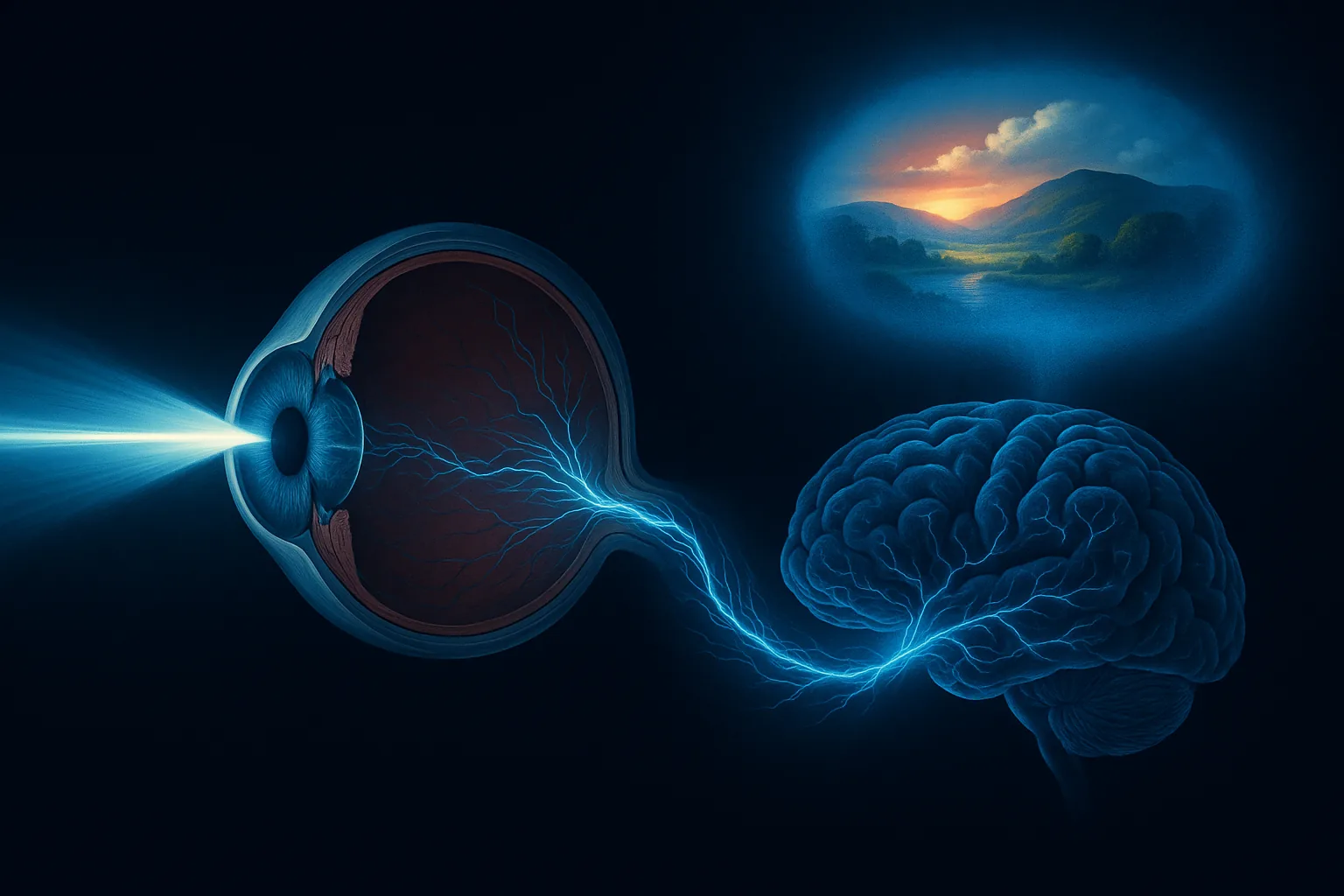
Look at anything—a tree, a face, this page. It feels as though you are seeing the thing itself, directly, the way a window reveals the street outside. But you are not. What actually happens is a chain of three transformations: the world emits light waves, the eye converts those waves into electrical signals, and the mind—the great constructor—builds the image you experience from those signals. Sight is not a window. It is a pipeline.
The wave arrives: What light actually is
Before anything can be seen, there must be light. Light is an electromagnetic wave—a rippling field of energy travelling at nearly 300,000 kilometres per second. Different wavelengths carry different energies, and our eyes are tuned to just a tiny slice of the spectrum, roughly 380 to 700 nanometres. That narrow band is called visible light. Everything else—radio waves, microwaves, X-rays—is invisible to us, not because it does not exist, but because we have no receptors for it.
Here is the first surprise: objects do not have colours. A red apple does not emit redness. It absorbs most wavelengths of light and reflects the rest. The wavelengths it reflects are what reach your eye. Colour, in other words, is not in the world—it is a label your brain will later assign to a particular wavelength. The wave itself is colourless.
The eye: A lens that turns waves into signals
The eye is a precision instrument designed to capture light waves and convert them into a form the brain can process. Its parts function like a camera, but it operates as a transducer—an energy converter.
- Cornea and lens: Light enters through the transparent cornea, passes through the pupil (the opening controlled by the iris), and is focused by the lens onto the back of the eye. Muscles adjust the shape of the lens to bring near and far objects into focus, a process called accommodation.
- The retina: The focused image lands on the retina, a sheet of light-sensitive tissue at the back of the eye. The retina is not a screen; it is a living array of sensors containing two types of photoreceptor cells: rods and cones. Each eye has roughly 120 million rods and 6 million cones.
- The conversion: Inside each photoreceptor is a pigment molecule, such as rhodopsin. When a photon of light strikes it, the molecule changes shape, triggering a chemical cascade that alters the cell’s electrical state. In a fraction of a millisecond, a light wave becomes an electrical signal—the language of the nervous system.
The brain never sees light. Everything downstream is signal processing.
The signal travels: wiring the image to the brain
Electrical signals from the retina are collected by ganglion cells, whose fibres bundle together to form the optic nerve—a cable of about one million wires leaving the back of each eye. At the optic chiasm, fibres from the inner half of each retina cross to the opposite side of the brain, so that what you see on your left is processed by the right hemisphere, and vice versa.
Already the image is being broken down. The retina does not send a complete picture. It transmits patterns of pulses, with different groups of cells specialising in reporting colour differences, motion, or edges.
The mind creates the image
This is where seeing becomes a creative act. In the brain, scattered signals are reassembled into a coherent scene. Different regions respond to lines at particular angles, motion in specific directions, and boundaries between light and dark. Higher areas combine these fragments into faces, objects, and places. Separate processing streams handle what something is and where it is.
The brain and mind does not merely receive information—it actively edits it:
- It fills gaps: Where the optic nerve exits the retina, there are no photoreceptors, creating a genuine blind spot in each eye. You never notice it because the brain fills the hole with its best guess based on the surrounding scene.
- It stabilises: Your eyes move several times per second, yet the world appears steady. The brain compensates for these movements so the scene does not jump.
- It predicts: The brain does not passively wait for signals. It anticipates what should be there and uses incoming data to correct or confirm its predictions. Much of what you “see” in familiar environments is expectation, lightly checked against reality.
- It labels: Colour constancy allows a white shirt to appear white even under orange lamplight, despite the change in wavelengths reaching your eye. The brain is not reporting the light—it is interpreting it.
Optical illusions demonstrate this clearly. When two identical grey squares appear different due to their surroundings, or a straight line looks bent next to curves, you are not seeing a flaw in the world—you are witnessing the mind’s editing in action.
The rendering
So where does the image exist? Not in the eye, and not in the signals themselves, which are merely pulses of electricity. The image exists only in the mind’s construction: a model of the world assembled from millions of tiny reports, filled in where data is missing, stabilised during eye movements, and coloured by labels the brain applies.
This is why sight is the perfect starting point for decoding the matrix. Every moment of visual experience demonstrates that you do not perceive reality directly—you perceive a rendering. The world sends waves, the eye translates them, and the mind paints the picture. Once you understand that the image is constructed, you can begin to ask what else the mind might be building while it builds the scene in front of you.