Hearing: How Sound Waves Become the Voice in Your Mind
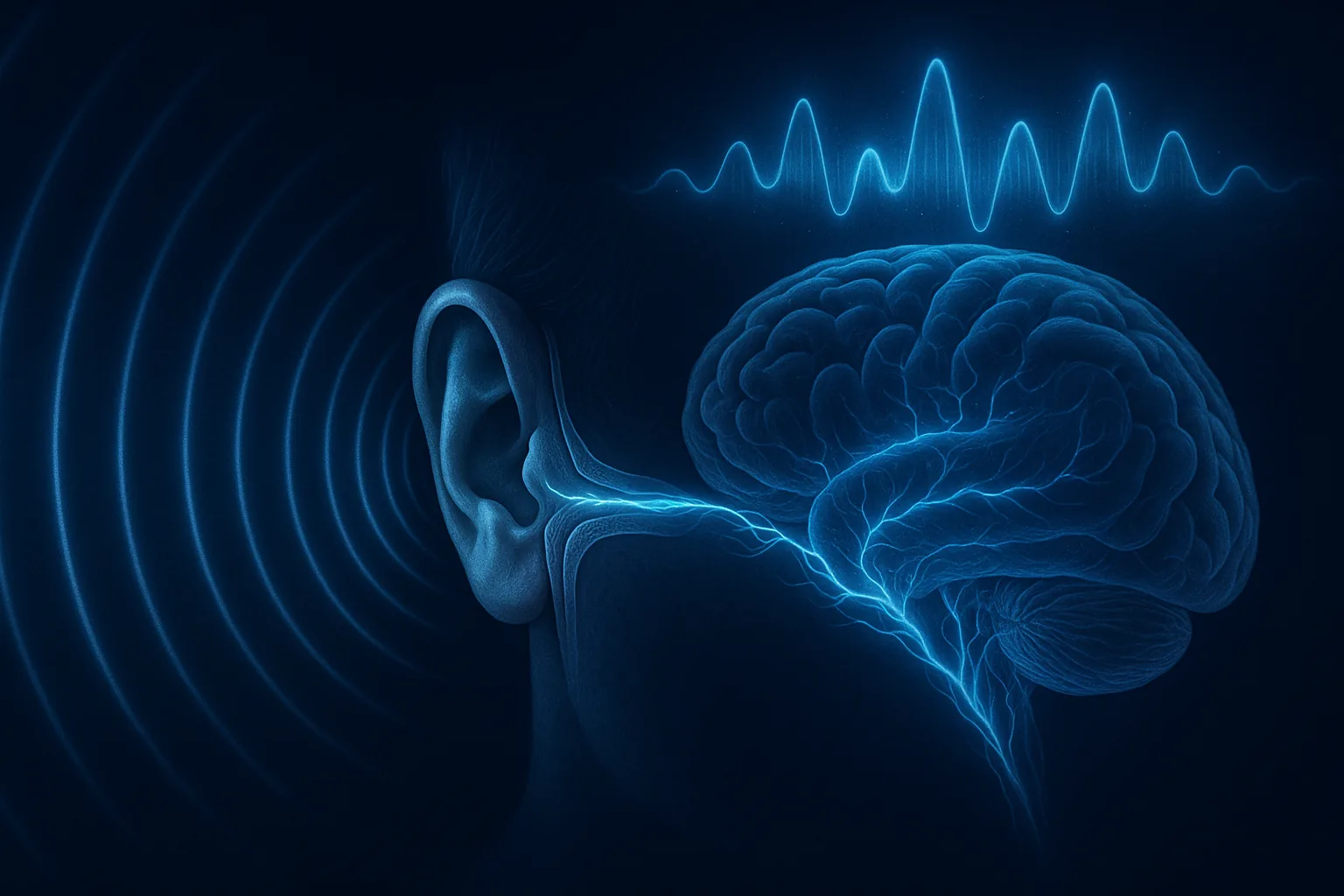
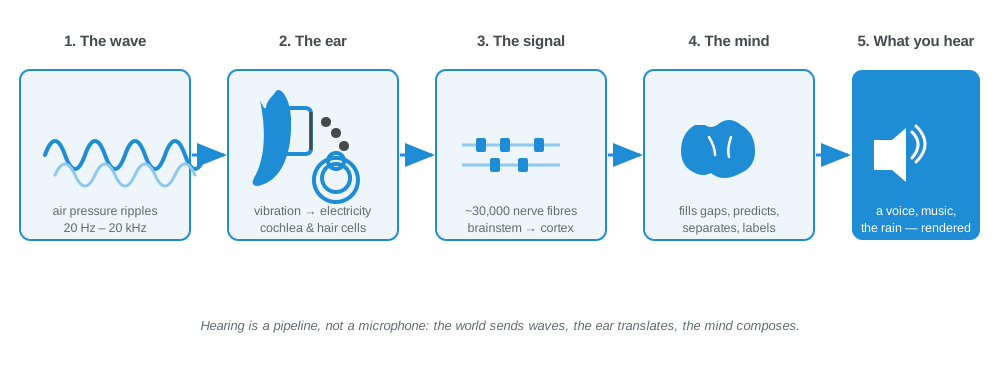
Listen to anything — a voice, music, rain on a roof. It feels like the sound is arriving whole, the way a radio delivers a broadcast. But it is not. Hearing is a chain of three transformations: the world sends out pressure waves, the ear converts those waves into electrical signals, and the mind — the great constructor — builds the sound you experience from those signals. Hearing is not a microphone. It is a pipeline.
The wave arrives: What sound actually is
Before anything is heard, there must be a disturbance. Sound is a pressure wave — a ripple of compression and rarefaction travelling through air, water, or solid matter at about 343 metres per second at sea level. A struck guitar string pushes the air beside it, that air pushes the next layer, and the disturbance travels outward like a wave across water. The wave moves; the air mostly stays put.
Two properties of the wave become two properties of experience. Frequency — how many compressions pass per second, measured in hertz — becomes pitch: slow waves sound low, fast waves sound high. Amplitude — how much the pressure rises and falls — becomes loudness. And here is the first surprise: sound waves carry no meaning, in the same way light carries no colour. A scream and a whisper are both just air pressure. The emotion, the words, the warning — all of that is added later, by the brain.
Human ears are tuned to a slice of the acoustic spectrum, roughly 20 to 20,000 hertz. Below that lies infrasound — the rumble of earthquakes and distant storms. Above lies ultrasound — the cries of bats and dolphins. Both are real vibrations in the air, as real as the ones you hear. You do not hear them not because they do not exist, but because you have no receptors for them.
The ear: A funnel that turns pressure into signals
The ear is built for one job: catching pressure waves and converting them into electrical signals the brain can read. It works like a transducer — an energy converter — and it does the job in three stages.
- The outer ear: The pinna, the visible part of the ear, is not a decoration. Its folds filter sound subtly, and the brain learns those filter patterns, which helps it judge whether a sound comes from above, below, in front, or behind. The wave then travels down the ear canal to the eardrum, a thin membrane that vibrates with the pressure changes.
- The middle ear: The vibration is tiny — at the very threshold of hearing, the eardrum moves less than the width of an atom — so it needs amplification. Three tiny bones, the ossicles (hammer, anvil, stirrup), lever the vibration across the air-filled middle ear and concentrate it onto the oval window, a membrane about twenty times smaller than the eardrum. The pressure is multiplied roughly twenty-fold. Without this mechanical amplifier, most sound would simply bounce off the fluid of the inner ear.
- The inner ear: Beyond the oval window lies the cochlea, a spiral, fluid-filled tube about the size of a pea. Running its length is the basilar membrane, and on that membrane sit rows of microscopic hair cells. When the fluid moves, the membrane ripples, the hair cells bend, and that bending opens ion channels — the same trick photoreceptors use. In a fraction of a millisecond, a pressure wave has become an electrical signal, the language of the nervous system.
The cochlea is also a frequency analyser. The basilar membrane is stiff near the entrance and floppy at the tip, so high frequencies peak near the base and low frequencies travel further before peaking. Each pitch activates a different place along the membrane — a built-in map of frequency called tonotopy. The ear does not send “sound”; it sends a spatial report: these cells fired, here, now.
The signal travels: Wiring sound to the brain
The hair cells connect to the auditory nerve — about 30,000 fibres, a thin cable compared to the optic nerve’s million. The route is not a straight copy. From the cochlea the signal goes first to the cochlear nucleus in the brainstem, where it begins to be sorted. Then, almost uniquely among the senses, it splits: part crosses to the opposite side of the brain, part stays, so each ear feeds both hemispheres.
At the superior olivary complex, the brain performs its first act of geometry. A sound from your left reaches your left ear a fraction of a millisecond before your right — down to about ten microseconds of difference — and arrives slightly louder. The brain measures both differences and computes a direction. This is the origin of stereo: not in the ears, but in the comparison the brain makes between them.
The mind creates the sound
And now the strange part — the part that makes hearing a creative act. The auditory cortex reassembles the scattered reports into an acoustic scene. Different groups of cells respond to pitch, to loudness, to where a sound comes from, to how it changes over time. Higher areas recognise the shapes in the sound: a voice, a word, a door closing, a familiar song.
The brain does not stop at reception. It edits:
- It fills gaps: If a cough masks a word in the middle of a sentence, you still hear the whole sentence — the brain reconstructs the missing syllable from context and inserts it. This is phoneme restoration, and it is why you understand a friend in a noisy room more easily than a stranger. A tone briefly interrupted by a burst of noise is heard as continuous, because the brain assumes the sound went on behind the noise. The same constructive stitching turns the continuous acoustic stream of speech into clean syllables and words: you hear “thank-you” as two crisp packets even though the pressure wave itself has no spaces.
- It stabilises: Your head moves and your ears move with it, yet the world of sound stays put. A voice stays in place as you turn your head, because the brain recomputes location on the fly and holds the scene steady.
- It predicts: The brain does not wait passively for signals; it anticipates. In a crowded room, your brain locks onto one voice and follows it while suppressing the others — the cocktail party effect — yet it is ready to switch the instant your name is spoken across the room. You hear what you expect to hear, corrected by what actually arrives.
- It labels: The same wave can be heard as speech, music, or noise depending on what the brain decides it is. In speech the brain carves the flow into syllables and phonemes; in music it groups notes into motifs, phrases, and rhythms — hearing a melody’s “syllables” even when the sound is continuous or richly harmonic. And hearing is not even purely acoustic: in the McGurk effect, when the sound of one syllable is paired with the sight of lips forming another, you hear a third syllable that matches neither — the brain fuses the two channels into a single verdict.
Auditory illusions are the proof. A Shepard tone seems to rise forever, like an endless staircase of pitch, even though it never actually goes up. The brain’s own editing makes the impossible sound real.
The rendering
So where is the sound? Not in the wave — the wave is just air pressure. Not in the ear — the ear sends pulses. The sound you experience — the voice, the music, the rain — exists only in the mind’s construction: a model of the acoustic world assembled from scattered reports, filled in where data is missing, stabilised as your head moves, and labelled by decisions the brain itself makes. Every syllable you hear in speech and every melodic or rhythmic unit you hear in music is further evidence of that construction.
That is why hearing is the perfect place to continue decoding the matrix. Every moment of your auditory life is a demonstration that you do not perceive reality directly — you perceive a rendering. The world sends waves; the ear translates; the mind composes. And if the mind composes what you hear, it is worth asking what else it is composing while you listen: the meaning in a sentence, the mood in a room, the confidence in a voice. Those too are renderings. And a rendering can be examined.